Showing posts with label 2006. Show all posts

Acura RDX Prototype (2006)

yosep | 11:32 AM | 0 comments

The highly anticipated Acura RDX Prototype SUV debuted today at the North American International Auto Show. Combining sport utility with sports sedan handling and performance, RDX features an innovative 2.3-liter four-cylinder turbocharged engine, Acura's exclusive Super Handling All-Wheel Drive(TM) (SH-AWD(TM)), and is designed to redefine the entry premium SUV segment. This near-production prototype provides an advance preview of the all-new RDX that will go on sale this summer.

"The RDX Prototype represents the forward thinking that will be seen in the next generation of Acura light trucks," said John Mendel, senior vice president, Auto Operations. "It is loaded with leading edge technology and it exemplifies what we call intelligent performance: a sporty, luxurious and functional SUV that has outstanding performance yet is also fuel efficient."

RDX features an all-new 2.3-liter i-VTEC(R) four-cylinder turbocharged engine that generates 240 horsepower and 260 lbs-ft of torque. This is the first application of forced induction technology in Acura history. The revolutionary i-VTEC Turbo technology uses a variable flow turbocharger, which is exclusive to the RDX, and provides dramatic performance benefits while maintaining excellent fuel efficiency. To complement the all-aluminum high-performance engine, the RDX utilizes Acura's steering wheel-mounted paddle shifters to manually operate the 5-speed sequential SportShift(TM) automatic transmission.

Acura's Super Handling-AWD system is tuned specifically for the new RDX platform. SH-AWD's sophisticated electronic controls automatically distribute torque fore and aft, as well as splitting the rear torque left to right. The result is dramatically enhanced handling, traction and stability during sporty driving as well as in inclement weather. A sophisticated chassis with fully independent front and rear suspension complement the SH-AWD. Vehicle Stability Assist (VSA(R)) combines with large disc brakes and ABS to enhance control.


Acura RDX Prototype

Acura RDX Prototype

Acura RDX Prototype

Acura RDX Prototype

Acura RDX Prototype


The RDX is built on an all-new global light truck platform. Reflecting Acura's commitment to safety through innovation, the RDX is equipped with the Advanced Compatibility Engineering(TM) (ACE(TM)) body structure and additional state-of-the-art safety features. The ACE structure helps to disperse collision forces over a larger frontal area. The system also helps to provide enhanced protection for vehicle occupants while at the same time increasing compatibility with other vehicles in a frontal collision. Front, side and side curtain airbags, in addition to rollover sensors add an extra measure of safety.

The chiseled exterior styling combines with a generous greenhouse to provide excellent visibility for driving in city traffic or on twisty mountain roads. RDX employs a compact upper body with an aggressively raked belt line, sporty wheel flares and a substantial hood that flows down from the windshield to an aggressive Acura signature five-sided grill. Custom 19-inch alloy wheels give the RDX Prototype an aggressive stance. Dual exhaust tips, HID headlights, and a rear spoiler add to the sporty appearance of the vehicle.

Inside, the RDX combines richly appointed materials with a sporty, driver-oriented cockpit. The center console features an innovative storage system, which allows for hidden and lockable storage of a briefcase or laptop computer. The prototype's interior features an assortment of leading-edge technologies, such as the Acura Navigation System with Voice Recognition(TM), AcuraLink(TM) satellite communication system with real time traffic and HandsFreeLink(TM) wireless telephone interface. A premium Acura/ELS(TM) DVD-Audio system is tuned to deliver rich surround sound to the cabin.

The RDX offers seating for five and a versatile rear cargo hatch allows for easy load-in and storage. The second row seats split and fold flat into the floor, providing ample cargo space for an active, on-the-go lifestyle.

Acura MD-X Concept (2006)

yosep | 11:27 AM | 0 comments

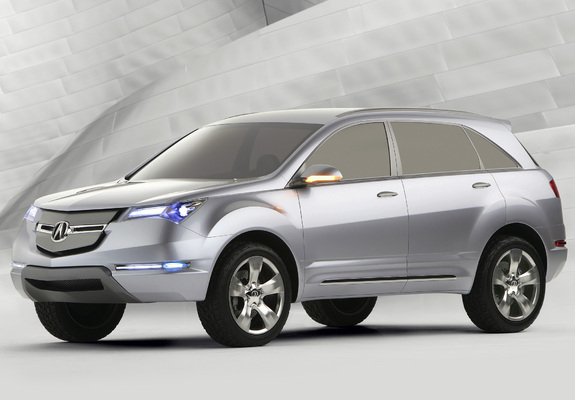
The Acura "MD-X Concept" luxury performance SUV made its world debut today at the 2006 New York International Auto Show featuring bold, sleek exterior styling indicative of the next generation MDX production model.

"Every aspect of the MD-X Concept design conveys performance while still retaining SUV functionality," said John Mendel, senior vice president, auto operations. "The styling signifies a bold direction for the next generation MDX, both in appearance and substance."

The MD-X Concept is fashioned as a true driver's SUV, with its low, wide stance and aggressive design. Its sleek surface lines are modeled after a high-powered megayacht.

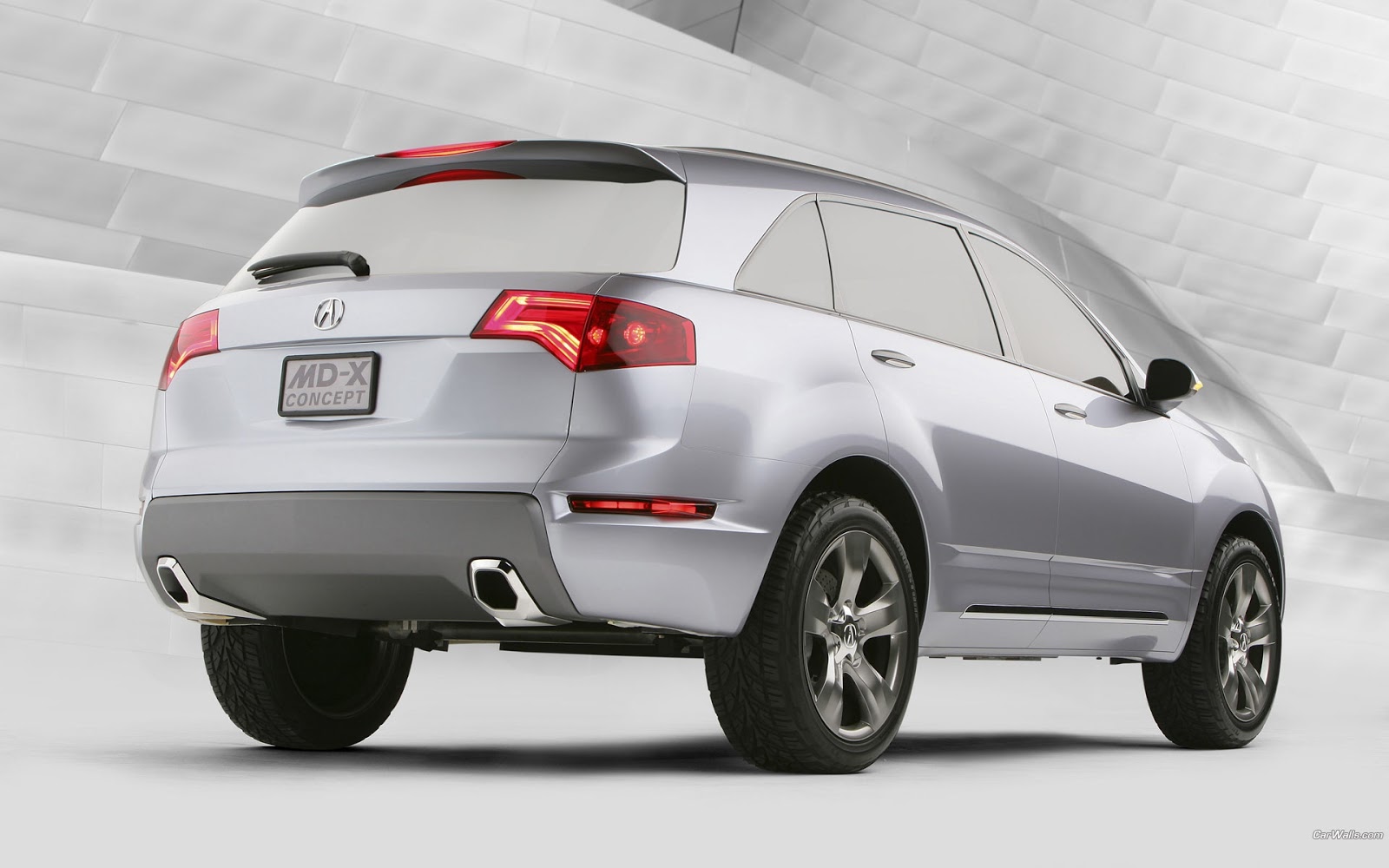
The MD-X Concept features a wider track and longer wheelbase that give the vehicle a sportier, performance look. The profile of the concept reveals a refined SUV with smooth, chiseled lines and an elegant form. A dominant character line runs from the front quarter panel to the rear, evoking the feeling of forward movement. The sharply raked D-pillar creates a stealth, aerodynamic appearance while still retaining the third row seating functionality and cargo carrying capability of the current generation MDX.


Acura MD-X Concept

Acura MD-X Concept

Acura MD-X Concept

Acura MD-X Concept

Acura MD-X Concept


The Concept sits low to the ground despite the large 20-inch five-spoke custom alloy wheels, while the large wheel arches and flares add to the Concept's muscular appearance. The sleek cabin features flush mounted windshield glass, which improves aerodynamics while adding to the MD-X Concept's smooth and flowing design.

"The smooth lines and sleek shape of the MD-X Concept challenge the conventions of SUV design," said Ricky Hsu, chief designer for the MD-X Concept. "Our goal was to create the image of a sports sedan while maintaining generous interior volume and utility of a SUV."

The front hood is accented with pronounced character lines culminating in an aggressive five-sided grille, which gives the MD-X its bold presence. The commanding front grille features a dominant center bar running through a solid aluminum face. The narrow, Xenon High Intensity Discharge (HID) headlights appear to grow out of the massive grille, giving the overall front-end a strong, distinct look.

"The front end of the MD-X Concept communicates power and prestige," explains Hsu. "We want drivers to do a double-take when the vehicle passes them on the road."

In the rear, the MD-X Concept has an integrated rear hatch, which sits flush against the bumper to create a smooth, clean appearance. LED taillights wrap around the cargo hatch adding to the vehicles wide and low appearance. A rear spoiler improves aerodynamics and the integrated dual exhaust pipes add to the SUV's sporty style.

Acura Advanced Sedan Concept (2006)

yosep | 11:23 AM | 0 comments

"The Advanced Sedan Concept illustrates Acura's commitment to modern design and cutting-edge style," said John Mendel, senior vice president, auto operations."With our advanced design team taking a significant role in shaping future vehicle design, we can expect upcoming products to reflect this progressive, forward-thinking styling."

The Advanced Sedan Concept is the purest expression of advanced design, performance and luxury, highlighted by its powerful, wide stance and deeply sculpted surfaces. The primary goal of this design study was to create a sophisticated, refined sedan with a mysterious presence.

The concept's generous exterior proportions suggest that a large, powerful engine lurks beneath the surface. The exterior lines reveal a sheer, sculpted lower body contrasted with a taut, architectural cabin. Although ultra-modern in its design, the concept retains the classic silhouette associated with a flagship sedan.

Low to the ground, the concept is anchored by large 22 inch front and 23 inch rear tires which are mounted to custom billet-machined, polished aluminum wheels. Powerful brake discs and calipers accent the wheels and large ducts direct cooling air to the components. Bold wheel arches and flares add to the concept's muscular appearance.


Acura Advanced Sedan Concept

Acura Advanced Sedan Concept

Acura Advanced Sedan Concept

Acura Advanced Sedan Concept

Acura Advanced Sedan Concept


The sleek, compact cockpit nestles atop the sculpted body and flows from hood to trunk. For a unique panoramic view, the roof is constructed entirely of tinted glass that shades the occupants while still connecting them to the outside world.

"We wanted to capture the essence of an ultra luxurious sedan but give it a striking, mysterious presence to create a vehicle with a dual personality," said Dave Marek, chief designer, Honda R&D Americas, Inc. "The concept echoes this quality with its clean exterior lines, a wide, stance, high performance cues and key luxury accents."

The hood is accented with pronounced character lines that culminate in the aggressive five-sided grille, which contributes to the sedan's bold presence. The commanding grille is constructed of polished aluminum and features a cut crystal Acura emblem. The narrow headlights also double as air intakes and are positioned low on the bumper, further enhancing the sedan's already commanding 79.5 inch width.

"The front of the sedan communicates power and luxury," explains Marek. "The pronounced hood and large grille communicate performance, while the jewel-like Acura emblem captures the essence of pure luxury."

In the rear, the Advanced Sedan Concept has a flush mounted rear bumper with the high-mounted stop lamp integrated into the center break of the trunk. The jeweledtaillights are pushed to the outer edge of the bumper to further enhance the vehicle's wide and low appearance, while integrated dual exhaust outlets complement the sedan's performance-oriented style.

During the past decade, several Acura vehicles have been designed and developed in the U.S. including the award winning MDX luxury SUV, the innovative TL performance luxury sedan and the all-new RDX turbocharged crossover SUV. Acura will continue the expansion of its U.S. design capabilities with the addition of a dedicated Acura Design Center that will open next year in Torrance, Ca.

Aston Martin Rapide Concept (2006)

yosep | 3:26 AM | 0 comments

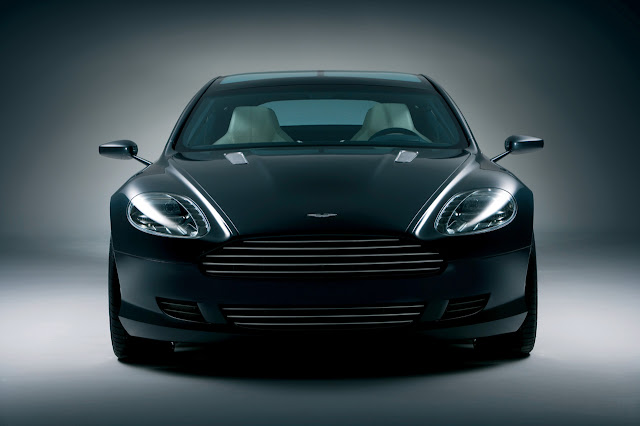
The Aston Martin Rapide concept is a four-door, high performance coupé of remarkable grace and poise. Based on Aston Martin's unique VH (Vertical/Horizontal) architecture, the Aston Martin Rapide combines the company's commitment to power, beauty and soul with space and practicality for every eventuality. It stands for stylistic excellence, market innovation and flexible manufacturing. The Aston Martin Rapide is the epitome of Aston Martin's low-volume, high-technology approach, the synergy of modern methods and materials with traditional skills to create a new form of craftsmanship for the 21st century.

While the Rapide retains Aston Martin's inherent design characteristics the additional length and extra doors build upon the Aston Martin DB9's taut, poised stance, generating a natural, even flow and a dynamic sensation that's conveyed even when the Aston Martin Rapide Concept is standing still. "In terms of elegance the Aston Martin Rapide is adding value to the DB9's undisputed elegance and subtle understatement," says Dr Ulrich Bez, Chairman and Chief Executive Officer of Aston Martin. "Our cars must look beautiful from all angles, and the four-door is very well balanced." Practicality and power are the Aston Martin Rapide's signature qualities, but above all it is recognisably an Aston Martin, a testament to the strength of the marque's design language. The Aston Martin Rapide's four-door body provides greater access to the extended architecture, making it a performance car for every occasion. "The proportions must be perfect," says Dr Bez, "if we couldn't achieve this then we wouldn't have made the car."

Aston Martin Rapide Concept

Aston Martin Rapide Concept

Aston Martin Rapide Concept

Aston Martin Rapide Concept

Aston Martin Rapide Concept

ARCHITECTURE

Underpinning the Aston Martin Rapide concept is Aston Martin's VH architecture, developed to offer exceptional manufacturing flexibility. This high-strength, low-mass architecture forms the backbone of the current generation of Aston Martins, spearheaded by the DB9 Coupé and flanked by the Aston Martin DB9 Volante and the Vantage.

The extruded aluminium construction of the VH architecture can be modified in both length and width, providing a myriad of packaging options, and the chemically-bonded structure (using glues derived from aircraft manufacture) is mated with bodywork that mixes aluminium and composite materials. The architecture's flexibility is further demonstrated by its use in the Aston Martin DBR9 racing car, where it is combined with carbon-fibre composite body panels to produce a modern race car of rare beauty.

Aston Martin's traditional hand-finishing, craft skills and attention to detail operate side by side on the ultra-modern production line at Gaydon in Warwickshire. The VH architecture is at the heart of this manufacturing operation, its modular structure providing such inherent rigidity that it has given the company's designers and engineers the same levels of freedom as their predecessors, 50 years before. In today's marketplace, even low volume manufacturers like Aston Martin are governed by strict legislation and the need to balance power, weight distribution, handling and safety. Utilising the VH architecture as the foundation for the Aston Martin Rapide concept, Aston Martin has illustrated how their current range might be expanded, a four-door coupé that complements the formidable DB9 2+2, DB9 Volante and the compact and muscular Aston Martin V8 Vantage.

DESIGN ETHOS: EXTERIOR
The visual language of Aston Martin is highly distinctive. Across a range of three cars, the company's design team, led by Design Director Marek Reichman, fulfils Aston Martin's core values - power, beauty and soul - with bodywork that is taut, poised and muscular. "The brand is about the driving experience," says Reichman, explaining how the concept is intended to provide everything customers have to come to expect from an Aston Martin, and more. "We wanted to make the most beautiful four-door car in the world," he says, as he traces the Aston Martin Rapide's development from a series of exploratory sketches in the Summer of 2005 to the finished, fully-functioning prototype. In the process, Reichman and his team explored the way the Aston Martin Rapide might be used, where and when it would be driven, even who would be driving. The four-door body was a natural way of providing access to the Aston Martin Rapide's increased interior space, part of Aston Martin's commitment to design usability. "If there's a space then you should also offer accessibility, otherwise you're not being honest," explains Dr Bez.

Reichman describes the 'beautiful harmony' of the line that runs through the Aston Martin Rapide's bodywork, giving the car the appearance of motion even while stationary, an athlete in flight, rather than crouched and coiled upon the starting blocks. "It's not a wedge, it's graceful and flowing," he explains, "we decided to let the lines flow right through the body to the tail, which ends very beautifully. In silhouette, the Aston Martin Rapide shares the same sinuous line as its two-door siblings, although when compared with the poised stance of the Vantage with its sprinter-like forward thrust, the Aston Martin Rapide is a long distance runner." Reichman believes that proportion is fundamental to how a car is perceived. "There are forms that appear at ease and forms that appear tense and uncomfortable," he says, "we wanted to make everything on the Aston Martin Rapide work in harmony." Achieving this required the intuitive skills of Aston Martin's modelling team, who work with both raw clay models and advanced computer modelling. "We put character and feeling into the surface," says Reichman. "Our designers and modellers work with a sculptural language here at Aston Martin - the play of light on the surface are incredibly important to us." Full-scale models are viewed in daylight and dusk conditions, for example, to ensure that the dramatic surface forms remain an integral element of each and every Aston Martin. Reichman believes that technology like the VH architecture allows him "to keep the form language and soul of the product."

The Aston Martin Rapide represents the pinnacle of Aston Martin's design ethos, a formal language developed through the carefully balanced combination of elegance and aggression. In silhouette, three-quarters view and from both the front and rear, the Aston Martin Rapide is instantly recognisable as an Aston Martin, regardless of whether it is wearing the famous winged badge (still faithfully rendered in pewter and enamel on every model). The soft curves of the flank kick up into muscular haunches above the rear wheel arches, with the roofline staying low, true to the distinctive Aston Martin silhouette. The Aston Martin Rapide also features the metal side strakes, another signature feature, while the doors feature Aston Martin's unique 'swan wing' design, opening upwards at a 12-degree angle away from the kerb to provide greater access. The rear doors cut unexpectedly deep into the flank below the C-pillar, increasing the width of the opening to improve access. At 5m long, the Aston Martin Rapide is 30cm longer than a DB9, and only 140kg heavier. "Aston Martin should always be about the proportions," Reichman says. "Although the Aston Martin Rapide is slightly taller than the DB9, the proportion of the section is the same, allowing the flowing lines to encase a spacious passenger compartment."

DESIGN ETHOS: INTERIOR
The Aston Martin Rapide continues Aston Martin's reputation for highly-tailored, individual cockpits. The trademark glass starter button is a small element of theatre that is also beautiful and tactile, the perfect first point of contact with the car. Providing sporty accommodation for four passengers in such a low and beautiful coupé presents a formidable packaging challenge.

Sitting low to the ground, just four centimetres higher than a DB9, the interior is an exquisite leather-swathed package, with custom-embossed shagreen hide specially sourced for the Aston Martin Rapide. "It's very cosseting," admits Reichman, "it's about creating a personal experience of the journey." Like a set of exquisite hand-tooled luggage, the interior is compact yet also surprisingly spacious, with great attention to detail, like the extensive map and accessory storage and the mood lighting that maximises the feeling of volume.

Aston Martin has always been about truth to materials: wood is valued for its structural properties and appearance, as are aluminium, glass and leather, while carbon fibre is utilised for its strength and weight-saving abilities and not just a showy finish. A transparent polycarbonate roof brings an increased sense of spatial awareness, opening up the passengers' vistas beyond the driver's focus on the road ahead. This ultra-light transparent material is a first for the company. The Aston Martin Rapide has dual climate zones, and the luxuriously appointed rear seats come with their own DVD screens and controls for the audio system and environmental system.

The dashboard is very driver-focused, the three passengers can also be as engaged and involved in the journey. For example, the satellite navigation system is fully accessible to all passengers, with a handheld Bluetooth unit that allows rear seat passengers to add their input to the route ahead. It's this level of involvement that characterises the Aston Martin experience, and it is vital that both driver and passengers can share it.

The generous rear luggage compartment is accessed via a hatchback, a practical feature shared with the Vantage and the pioneering DB2/4 of 1952. In addition, each rear seat folds down individually, allowing for myriad interior options, be it three players plus three sets of golf clubs, or four people and their skis, which slot neatly above the central console. To give the concept a real sense of occasion, the feeling that every journey ends in an event, the interiors team have incorporated a chiller cabinet in the boot, perfectly shaped to hold a single Magnum of Jacquesson champagne, along with four elegant flutes.

The clock is an integral part of the Aston Martin Rapide's elegant dashboard. For this element, Aston Martin turned to their existing partners Jaeger-LeCoultre, world leaders in fine timekeeping and original manufacturers of dials in Aston Martins as far back as the 1929 1.5 Litre First Series. The Swiss watchmaker, which dates back to 1833, also created the exclusive AMVOX collection of understated gentlemen's timepieces. Aston Martin's engineers and designers collaborated with Jaeger-LeCoultre on the design of the Aston Martin Rapide concept's timekeeper, which takes on the characteristic traits of the AMVOX watches. The 270 degree sweep of numerals, dark grey dial with circular brushed surface, hands, numerals and raised sapphire crystal combine to make a beautifully refined object at the heart of the car, a series of sophisticated volumes created by the layers of the dials.

Alfa Romeo 159 Sportwagon (2006)

yosep | 3:17 AM | 0 comments


Italian styling, the performance and handling of a thoroughbred sports car, and the flexible, versatile use of space of a prestigious station wagon. These are, very briefly, the salient features of the Alfa Romeo 159 Sportwagon, the new car that will be on the market in Italy in March, followed by the other European markets.

It would be limiting to talk about the 'station wagon version' of the Alfa Romeo 159 because the car has a personality of its own and strong features that are summed up successfully in the definition 'Sportwagon'. The new model combines the flowing line of a long roof that recalls the styling of certain coupes, like the spoiler on the roof and the very aerodynamic lines. But at the same time, the car's interior space guarantees a generous, practical loading volume. In other words, the Alfa Romeo 159 Sportwagon provides the performance and dynamic behaviour you would expect from a sports car, and a luggage compartment with the dimensions of a prestigious station wagon, but also the versatility necessary for today's lifestyle.

Styling
Designed by Giorgetto Giugiaro in collaboration with the Alfa Romeo Style Centre, the 159 Sportwagon is as compact as the saloon - the total length is exactly the same (4,660 millimetres) - with a fluid line that runs without hesitation from nose to tail, focusing on a 'groove' which makes the entire car light and sleek, with a refined play of light and shade (it is 1,828 mm wide and 1,425 high, with a wheelbase of 2,700 millimetres).


Alfa Romeo 159 Sportwagon

Alfa Romeo 159 Sportwagon

Alfa Romeo 159 Sportwagon


The result is a sporty car on which the eye does not notice the 'extra volume' typical of a station wagon: this is the real strong point of the new model, which becomes all the more captivating where most station wagons reveal their main limitations. The Alfa Romeo 159 Sportwagon combines this winning feature with a luggage compartment that is a 'designed space' which meets a variety of requirements, whether it is used for leisure time or for business. And it never compromises where sportiness and performance are concerned. An example? The version equipped with the powerful 3.2 V6 Q4 24 valve engine, which delivers a maximum power output of 260 bhp (191 kW) at 6200 rpm and torque of 322 Nm (32.8 kgm) at 4500 rpm. The resulting performance is amazing: the Alfa Romeo 159 Sportwagon 3.2 V6 accelerates from 0 to 100 km/h in 7.2 seconds and reaches a top speed of 237 km/h.

The luggage compartment is more accessible than you would expect on a station wagon (both from the passenger compartment and from the back, thanks to the forward hinged tailgate) and the loading volume is excellent (445 litres), the result of a series of changes to the bodywork and a rational use of space.

The rear end speaks the same language as the rest of the car, blending styling details typical of Alfa and characteristic features of the saloon, with elements peculiar to the Sportwagon. A number of appropriate stylistic solutions such as the compact passenger compartment ensure that the new model maintains Alfa Romeo's classical sportiness. The front is unchanged, dominated by the same distinctive features as the saloon, with the harmonious balance that produces the elegance and assertiveness you expect from an Alfa Romeo.

Comfort
Quiet running, a comfortable climate and dynamic well-being: these are the features of the new model, achieved by sophisticated technologies, which create an ideal environment no matter how far you travel or how long you spend in the car. For example, the excellent articulation index which is on a par with the best competition. On the Alfa Romeo 159 Sportwagon you can converse normally, or listen undisturbed to music reproduced by the high fidelity BOSE® Hi-Fi Sound System with a central speaker on the facia for sharper acoustics. That is not all. Well-being on board is also enhanced by the automatic climate system with dual or tri-zone air distribution and temperature control, Cruise Control, rain, dusk, and front and rear parking sensors, a satellite navigator with maps (also with a 'Birdview' display), voice controls and a built-in GSM hands-free telephone, a split rear seat, windscreen heating in the wiper area, and elegant darker glazing for the rear side windows and rear window. And finally, the 'Home Link' device can be installed on the sun visor, and can be programmed to remotely open up to 3 electric gates.

Quality and roadholding
The Alfa Romeo 159 Sportwagon was designed for uncompromising quality, and was subjected to endless tests and controls throughout its development. The result is a car that offers not only Italian styling and the highest safety levels, but also superb roadholding. In fact, the most striking feature of all Alfa Romeos is the sensation of a car that is glued to the road and responds with unusual promptness to the steering wheel, so that the driver always knows exactly what the front axle is doing, what the grip limit is and what he has to do to put the front wheels where he wants them. The merit goes to the pinpoint steering and new suspension already adopted on the saloon: high double wishbones at the front for excellent lateral roadholding, great efficiency and precise response to the steering, and outstanding traction, and Multilink at the rear, which makes the car extremely stable in high speed manoeuvres and very agile on 'mixed narrow' roads, the sign of a true sports car. Like the saloon, the Alfa Romeo 159 Sportwagon with the powerful 3.2 V6 Q4 engine also proposes Q4 permanent four-wheel drive, with three differentials (the Torsen C self-locking central differential manages the drive torque, splitting it 57% to the rear wheel and 43% to the front wheels).

Safety
Like the saloon which was recently awarded the prestigious 5-star EuroNCAP rating, the new Alfa Romeo 159 Sportwagon confirms the extraordinary amount of attention its designers have focused on every aspect related to safety. Starting with preventive safety, which is guaranteed by the various technical solutions that help the driver to keep his mind on his driving: comfort, quiet running, climate control, an ergonomic driving position, the layout of the controls and legible instruments. Then there is active safety, in other words roadholding, braking capacity and complete control over the car's dynamic behaviour, thanks to ABS complete with EBD, the sophisticated Vehicle Dynamic Control system (VDC), Anti Slip Regulation (ASR), Hydraulic Brake Assistance (HBA) which intervenes during emergency braking, and a Hill Holder to simplify hill starts.

But it is in passive safety that the Alfa Romeo 159 Sportwagon really comes into its own. The new car fits innovative restraint systems (pretensioners on the clasps and decreasing load limiters on the seat-belts), as many as eight airbags (including special bags to protect the knees and sidebags, that extend all along the window area), and innovative front seats with an 'anti-whiplash' device that brings the head-restraint nearer to the occupant's neck in the event of a rear impact. The torsional rigidity of the Alfa Romeo 159 Sportwagon's bodyshell is unrivalled, and the merit goes to both the new 'premium' floorpan, the same used on the saloon, which is built with high performance materials, multiply sheet metal and laser welding, and to the numerous changes the Alfa Romeo engineers introduced to the bodyshell architecture. Thanks to this equipment and the other safety measures, the Alfa Romeo 159 Sportwagon easily meets the strictest standards for occupant protection. This has been demonstrated in numerous crash tests, slide tests and computer simulations.

Engines and gearboxes
The heart and soul of every Alfa Romeo model is its engine. The exciting styling and strong personality of every model hide a range of excellent engines with state-of-the-art technology and generous performance. The Alfa Romeo 159 Sportwagon is no exception. Like the saloon, it is powered by the three new JTS engines with continuous dual variable valve timing - the 3.2 V6 Q4 24v (260 bhp), the 2.2 (185 bhp) and the 1.9 (160 bhp) - and three Multijet engines: the 2.4 JTDm 20v (200 bhp), the 1.9 JTDm 16v (150 bhp) and the 1.9 JTDm 8v (120 bhp). A 1.8 litre petrol engine delivering 140 bhp will also be available at a later date. All the engines meet Euro 4 requirements. The diesel versions all incorporate a particulate trap (DPF), and they all deliver superb performance, combined with new mechanical gearboxes, all with six speeds, short strokes, precise engagement and limited loads. Automatic transmissions and a robotised Selespeed gearbox, also with six speeds, will be available on certain versions.

Volkswagen Tiguan Concept (2006)

yosep | 2:27 AM | 0 comments

Volkswagen has unveiled its compact 4x4, the Concept Tiguan, at the Los Angeles Auto Show, and has announced that the first examples of the SUV will be delivered to customers by the end of next year.

The first news of the Tiguan's development came with the debut of Concept A in Berlin earlier this year. This was followed by the naming of the model in July, the result of a poll of more than 350,000 readers of magazines of the AutoBild group. This latest development in Los Angeles takes the Tiguan one step closer to production and hints strongly at how the final version could look.

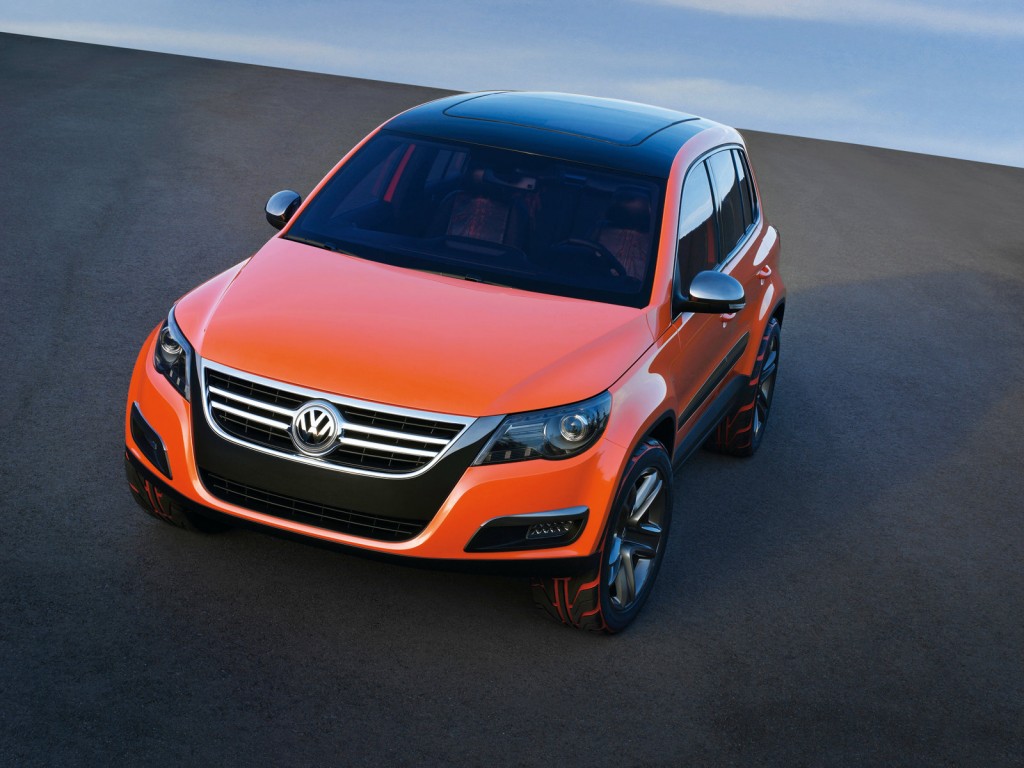
Maintaining the 'baby Touareg' appearance of the Concept A, Concept Tiguan makes a bold styling statement. At 4.4 metres long, 1.85 m wide and 1.69 m high, it is very similar in size to the Touran compact MPV (4.4 m, 1.8 m, 1.6 m). Klaus Bischoff, who was responsible for the exterior design of the car said: 'It was very important for us to have the car appear powerful and muscular. For us that was a higher priority than anything else. An off-roader needs a long hood and an upright position. That lends the vehicle self-assuredness and power.'


Volkswagen Tiguan Concept

Volkswagen Tiguan Concept

Volkswagen Tiguan Concept

Volkswagen Tiguan Concept

Volkswagen Tiguan Concept

Volkswagen Tiguan Concept


The Concept Tiguan's 'face' and side profile are immediately recognisable as those of a Volkswagen, and yet they are different from all existing models in the range. The dark-anodised metallic tone of the front grille contrasts with the body colour, while a grid pattern and two dominant cross fins to the left and right of the Volkswagen roundel complete the look.

Another feature is the Concept Tiguan's tyre design. These 19-inch prototypes, developed by Continental, have an orange radial stripe beneath the tyre profile which matches the car's paint colour. This colour is not simply painted on: it penetrates the rubber layer as a 'baked in' component of the tyre's casing. The eye-catching anthracite-coloured alloy rims are likely to feature in the production vehicle.

At the rear, the lights are integrated into the shoulder section similar to those on the Eos and Passat, while the steeply sloping tailgate extends right down to the bumpers, giving the Tiguan an unmistakably SUV design.

Inside the Concept Tiguan, the black, silver and orange colour theme continues. The vintage style black leather seats are trimmed with an orange pattern which mirrors that of the tyre tread. A panoramic sunroof adds light to the spacious interior which can seat up to five occupants, while to add versatility, the rear bench seat can slide fore and aft and be folded down to increase loadspace.

Under the bonnet, the concept car features a completely new type of diesel engine, called BLUETEC. Developed in partnership with Audi and Mercedes-Benz and presented for the first time at the LA show, BLUETEC employs a modular concept of different systems to reduce emissions significantly. One of these systems is the NOx storage catalytic converter which cuts nitrogen oxides by up to 90 per cent over current diesel units. This 'Clean TDI' will comply with the strictest emissions standards in the world and is one of the first components of the BLUETEC offensive.

More details on the Tiguan will be revealed in the first quarter of 2007. The car will go on sale in the UK early in 2008.

Articles By : netcarshow

Volkswagen Thunder Bunny Concept (2006)

yosep | 2:06 AM | 0 comments

Volkswagen introduces a concept vehicle that reflects its roots in the sport compact tuning community.

The story began back in the early '80s, with a man named Bill Neumann. Bill founded the California based tuning firm Automotive Performance Systems (APS). He was frustrated with the fact that Volkswagen's hot hatchback GTI had been sold in Germany since 1976, but hadn't yet come to America. Bill had driven the GTI in Europe on several of his parts-searching trips, and he was convinced it would be a big hit in America. So he sent letters to the factory. He wrote to enthusiast magazines and lobbied Volkswagen dealers for support. Then, he put together the proof that a Rabbit-based performance car was capable of generating both stunning performance numbers and lots of attention from the American automotive press corp.

Thus was born the original Thunder Bunny.
The APS-modified Rabbit was delivered to Motor Trend magazine late in 1981. Even though its staff was use to driving the best cars in the world, they were blown away by the little Volkswagen hatchback. As it was written in the March 1982 issue: "The little white wonder packs its own kind of lightning-quick rabbit punch — one that's guaranteed to kayo unsuspecting boulevard bullies." And when Road & Track magazine got its hands on the car, it reported a zero to 60-mph run in the low seven-second range and slalom times that at the time had been bettered only by the Ferrari 512 Boxer, Lamborghini Countach and Renault R5 Turbo. Exalted company, indeed.


Volkswagen Thunder Bunny Concept

Volkswagen Thunder Bunny Concept

Volkswagen Thunder Bunny Concept

Volkswagen Thunder Bunny Concept

Volkswagen Thunder Bunny Concept


Bill's frustration ceased in the fall of 1982 when the GTI finally came to America, but by then Thunder Bunny had done its job. It put Neuspeed, the APS-trademarked line of parts and accessories, on the map. It also helped launch a vital North American community of specialists in watercooled Volkswagen performance. Modifying Volkswagens, of course, was not new in America — the Beetle had spawned a huge following of enthusiasts — but the new generation of Volkswagen cars hadn't sparked much interest in the go-fast crowd before the early '80s.

Neuspeed continues to be a leading force among the world's Volkswagen tuners, and it has never stopped building special projects. The latest is also called Thunder Bunny, and it was built in commemoration of Neuspeed's quantum leap forward all those years ago with the original rabid Rabbit. Designed in collaboration with Derek Jenkins, Chief Designer at the Volkswagen Design Center California located in Santa Monica, the new Thunder Bunny is an updated, thoroughly modern version of the original, and it debuts alongside the Concept R GTI on the Volkswagen stand at the 2006 SEMA Show.

Today's Thunder Bunny is a blend of subtle design massaging and tuning technology, built to show how a comfortable daily driver can also provide an exciting motoring experience. Creating the thunderous noise from under the hood is a newly developed turbocharger system, designed by Neuspeed especially for Volkswagen's 2.5-liter five-cylinder engine. The high quality installation includes a modified intake manifold, Garrett ball-bearing turbocharger and air-to-air intercooler. A stainless exhaust and specially baffled aluminum oil pan were also sourced from APS for optimum flow and cooling. Boost is restricted to a maximum of seven lbs. in this Stage 1 kit, but it still produces 225 horsepower, 75 more than the stock 2.5 L, and a hefty dose of low-end torque. A performance clutch and Quaife differential were added to the powertrain for durability and a more efficient delivery of power to the front wheels.

Thunder Bunny's gleaming candy white exterior is made distinctive by several design studio touches. The concept's body kit includes a larger central grille and a more muscular rear valance framing a twin R32-style exhaust from Neuspeed. Like the R GTI, Thunder Bunny's paint was overlaid with graphics Jenkins calls "topographical" in pearl silver. They were meant to evoke the contours of the car's geography or waves of air that flow over the surfaces. However they are interpreted, the pearl silver graphics make a unique visual statement as they appear to blink on and off in the changing angles of the sun.

Like the original Thunder Bunny, the forged alloy "street" wheels are painted gold. In 19x8-inch sizing, they're wrapped with Michelin Pilot Sport Cup 235/35-19 tires. Similar sized multi-spoked forged alloys were sourced from Neuspeed's RS line of wheels for track use. Both sets are lightweight, in keeping with the core GTI quality of nimble handling. The front brakes are 328mm two-piece floating cross-drilled discs from Brembo, gripped by bunny-bedecked Brembo four-piston brake calipers. That's right, bunnies. A veritable warren of Thunder Bunny logos dash to and fro across the surface of the white-painted caliper. At the rear, 310mm disc brakes are fitted.

Handling prowess comes from a suspension fitted with a Bilstein coil-over shock system and APS/Neuspeed sways bars, measuring 25mm front and rear. The suspension system is adjustable for both ride height and for shock stiffness, giving the new Thunder Bunny a dual character, suitable for the street or the track. A Neuspeed short-shift kit and custom spherical aluminum shift knob, created in the design studio, put the driver in closer touch with the manual transmission. A stock GTI steering wheel was recovered in alcantara to go along with the upgraded upholstery and trim.

Stock GTI seats were recovered in black and white checkered tweed that echoes styling trends from the early '80s, and the striking fabric is elegantly framed by surrounding black leather with white stitching. The color scheme is perfectly complemented by the white carbon-fiber interior trim provided by OSIR, experts in hand-laid composites and also major contributors to the design studio's Concept R GTI.

All those years ago, Bill Neumann asked a simple question. Volkswagen responded with the GTI, while Neuspeed became a leader in Volkswagen tuner circles…why a new Thunder Bunny? Think of it as a beautifully crafted response to another question, "What happens when you give a modern Rabbit to one of the original water-cooled Volkswagen tuners?"

Articles By : netcarshow

Volvo XC90 (2006)

yosep | 2:34 PM | 0 comments
The Volvo XC90 was launched in early 2002 as the first purpose-built SUV (Sports Utility Vehicle) to come from Volvo Cars. It is also Volvo's first seven-seat car since the 1940s. The Volvo XC90 has electronically controlled All-Wheel Drive. It has the capacity to forge ahead on very poor roads, but is primarily intended as a spacious passenger car with excellent driving manners, immense safety and intelligent versatility.

Volvo XC90

Volvo XC90

Volvo XC90

Volvo XC90


Design
Five-door SUV - a crossover model that combines the passenger car's comfort and comfort with excellent get-you-there ability and flexibility. The Volvo XC90 is designed to give a robust yet at the same time compact and elegant impression. It is built as a passenger car, with a unitary body and the same type of chassis as that found in Volvo's sedan models - unlike some other SUV models that are built on a truck chassis. The Volvo XC90 comes with five or seven seats, depending on specification. The passenger compartment is very spacious, thanks not least to Volvo's modern powertrain concept with transverse engine installation.

The seats are placed high to give the driver a commanding view over the traffic and the passengers a comfortable seating position. All the passenger seats can be folded. The tailgate is divided into an upper and a lower section. This makes the Volvo XC90 a very flexible and versatile car. The top model in the range is the exclusive Volvo XC90 Executive, which features equipment and comfort of exceptional quality.
 
Support : Copyright © 2011. Auto Cars Concept - All Rights Reserved
Privacy Policy