Showing posts with label Volkswagen. Show all posts

Volkswagen Passat CC R-Line (2010)

yosep | 6:24 AM | 0 comments

R-Line equipment is already offered on seven Volkswagen models. Now the Volkswagen Passat CC R-Line has got a sportier touch. Orders are now being taken for the four-door coupé with R-Line package.

On its exterior, 17-inch (optional 18-inch) R-Line "Mallory" alloy wheels with 235/45 tyres lend a sporty touch to the Volkswagen Passat CC R-Line. The front spoiler and side skirts, each painted in body colour, were also re-styled. In addition, R-Line logos embellish the front side sections; the rear lights are smoked.


Volkswagen Passat CC R-Line

Volkswagen Passat CC R-Line

Volkswagen Passat CC R-Line

Volkswagen Passat CC R-Line

Volkswagen Passat CC R-Line


Inside the Volkswagen Passat CC R-Line, standard features include details like four customised tread plates in aluminium (with R-Line Logo in front) and a three-spoke leather-trimmed steering wheel with multifunction keys. The R-Line package has front fog lights and the Park Pilot system. The Passat R-Line leaves few wishes unfulfilled; even the base version of the Volkswagen Passat CC includes comfort and convenience features like sport seats and a climate control system.

The R-Line package is available with all Volkswagen Passat CC engines. Prices start at 2,200 Euros for the Passat CC 2.0 TDI (140 PS / 103 kW) with a 6-speed gearbox. Counting versions already introduced on the Golf, Scirocco, Touran, Tiguan, Passat, Passat Variant and Touareg, a total of eight models with R-Line equipment are now on the market.

Volkswagen Golf blue-e-motion Concept (2010)

yosep | 6:11 AM | 0 comments

2010 Volkswagen Golf blue-e-motion Concept is the five-door and five-seat version of the concept car driven by an electric motor integrated in the front engine compartment with a maximum power of 85 kW / 115 PS and a continuous power output of 50 kW / 69 PS.

It is more fun in zero-emissions driving. The electricity for powering the electric motor is stored in a lithium-ion battery with an energy capacity of 26.5 kilowatt-hours. It has weighs just 205 kg more than a comparable Golf BlueMotion TDI with DSG – despite the fact that electric car batteries are known to be heavy and weigh 1,545 kg in the concept car.

The zero-emissions Golf has enough performance potential to quickly execute manoeuvres such as passing. An index of the car’s very good dynamic qualities is its time for the sprint from 0 to 100 km/h: 11.8 seconds.

The Volkswagen Golf blue-e-motion Concept has an instrument that has the functions of each. The driver can see how much energy is being demanded by the “electric pedal” at any given moment on the kW gauge. A range indicator is also integrated in this round instrument. The speedometer, located on the right side as usual, integrates another small gauge that provides information on the battery charge state.


Volkswagen Golf blue-e-motion Concept

Volkswagen Golf blue-e-motion Concept

Volkswagen Golf blue-e-motion Concept

Volkswagen Golf blue-e-motion Concept

Volkswagen Golf blue-e-motion Concept


The concept car’s 30 battery modules – consisting of 180 lithium-ion cells (energy capacity: 26.5 kWh) – were installed in spaces adapted to the vehicle architecture. They can be found in the floor of the bootspace (fully usable cargo capacity: 275 litres), under the rear bench seat and in the centre tunnel of the underbody (between the front seats). A separate air cooling system ensures a constant thermal environment in the battery compartment. The battery modules weigh a total of 315 kilograms.

In battery regeneration, the driver has the option of pre-setting the braking energy recovery strategy over four stages (D to D3) via the automatic gearshift lever or gearshift paddles on the steering wheel.

Volkswagen Golf blue-e-motion Concept offers the three profiles “Normal,” “Comfort ” and “Range .”

Technical Data

Dimensions
Length: 4,199 mm
idth: 1,786 mm
Height: 1,480 mm
Wheelbase: 2,575 mm

Motor
Motor type: Electric motor
Power (max. / continuous): 85 kW / 50 kW
Max. torque: 270 Nm

Gearbox / Tyres
Gearbox: EQ 210 (1-speed transmission)
Drive type: Front-wheel drive
Tyre size: 205/55 R16

Driving performance
0-100 km/h: 11.8 s
Top speed (Comfort  mode): 135 km/h
CO2 emissions with electricity generated from renewable resources: Negligible

Volkswagen Golf R (2010)

yosep | 6:06 AM | 0 comments
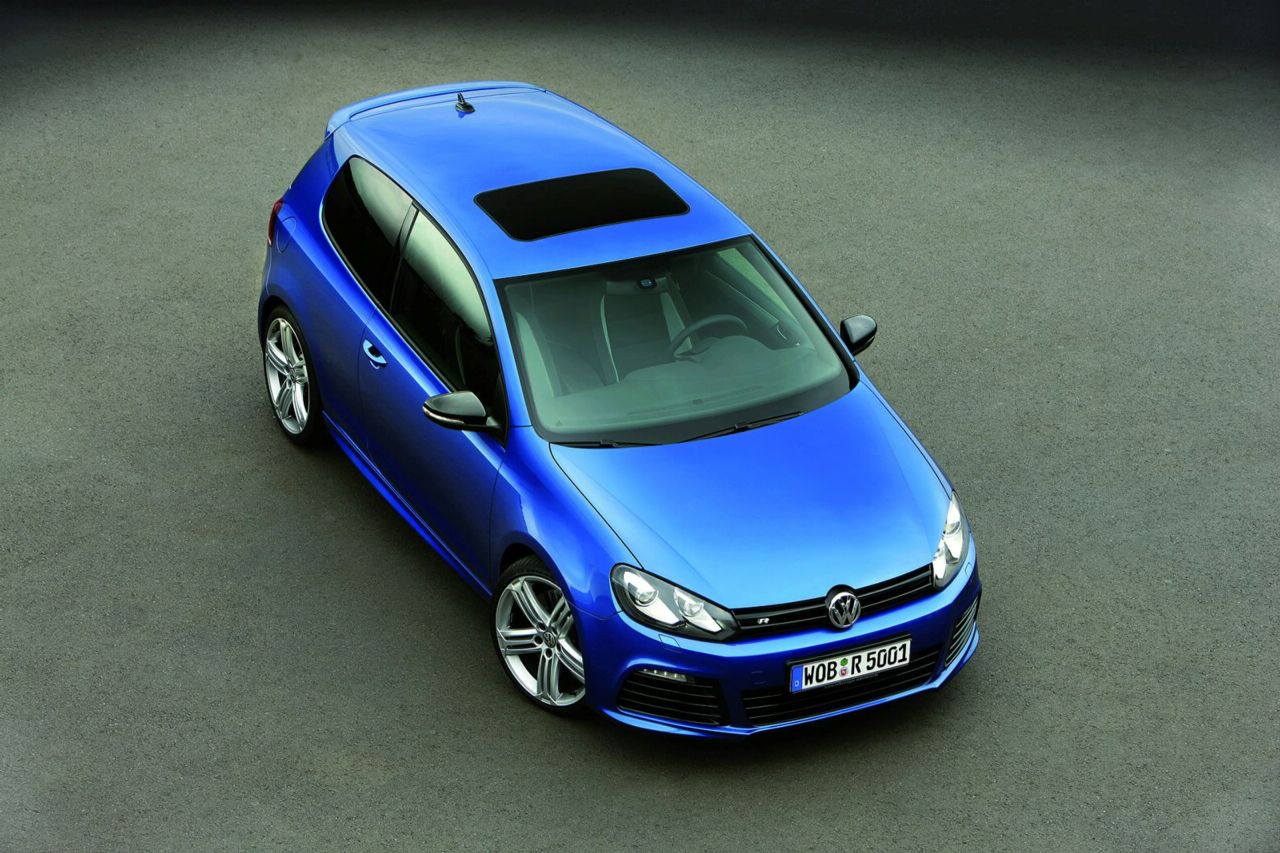
The Volkswagen Golf R equipped with a 2.0 liters TSI four cylinder engine with turbocharging and develops 199 kW / 270 PS at 6,000 rpm and 350 Nm of torque at 2,500 rpm.The Volkswagen Golf R can reach a limited top speed of 250 km/h and is able to get from 0 to 100 km/h in 5.7 seconds. The DSG returns 8.4 litres per 100km in fuel consumption and 195g/km of C02 emissions. The 6-speed manual averages 8.5 litres per 100km and its C02 emissions are 199g/km

Volkswagen Golf R

Volkswagen Golf R

Volkswagen Golf R

Volkswagen Golf R

Volkswagen Golf R


The equipment list of the Volkswagen Golf R includes very large air intakes with high-gloss painted louvers, LED daytime running lights strips, bi-xenon headlights, side skirt extensions, newly designed 18-inch alloy wheels (“Talladega” type) with 225/40 tyres (optional 19-inch version with 235/35 tyres), a rear diffuser and centrally-located twin tailpipes. The front suspension is a McPherson strut layout and the whole thing is lowered by 25mm.

The Volkswagen Golf R can be ordered in Germany starting at the end of this year.

Articles By : Lincah

Volkswagen Scirocco (2009)

yosep | 5:56 AM | 0 comments

Over 34 years after the original Volkswagen Scirocco sports coupé made its debut at the 1974 Geneva Motor Show, triggering a new era of design and paving the way for production of new vehicles which included the original Golf, the third generation went on sale.

The new VW Scirocco remains true to the formula that made the first generation Scirocco such a success - with iconic design, two doors, four seats, front engine and front wheel drive. Yet despite its historic roots, this latest car is the most dynamic and technically advanced production coupé Volkswagen has ever built.

The new Scirocco is wider and longer than the Golf GTI, but almost ten centimetres lower, emphasising its sports coupé character. Its looks are all-new, and its 'face', with the Volkswagen roundel moved from the grille to the bonnet, defined a new era of design for Volkswagen.

At launch in the UK in September 2008, just one engine and one trim level was available: the top-of-the-range 2.0-litre TSI with 200 PS in GT specification. Since then, a further 1.4-litre 160 PS TSI petrol unit and two 2.0-litre common rail TDI diesels with 140 or 170 PS have joined the line-up, along with a lower trim level.


Volkswagen Scirocco

Volkswagen Scirocco

Volkswagen Scirocco

Volkswagen Scirocco

Volkswagen Scirocco


All Sciroccos sold in the UK benefit from Adaptive Chassis Control (ACC), Volkswagen's innovative system which allows the driver to select from comfort, sport and normal modes to define the desired suspension, steering and accelerator response settings for any particular journey. Other standard equipment includes ABS with ESP (Electronic Stabilisation Programme), six airbags, alloy wheels and air conditioning (2Zone electronic climate control on GT models). Options include a panoramic sunroof, leather trim and touchscreen satellite navigation.

Even before launch the new generation of Volkswagen Scirocco proved extremely popular with more than 11,000 potential customers signing up to receive email updates about the new vehicle via the Volkswagen website three months prior to the car going on sale. In May 2008, a race car based on the road-going Scirocco, named the GT24, raced to success in its class at the Nürburgring 24-hour endurance rance and was invited to participate in the Supercar Run at the Goodwood Festival of Speed. With 325 PS, significantly altered dimensions and carbon fibre panels, the GT24 delighted crowds throughout the festival and paved the way for a successful market introduction of the road car

Since launch, the Volkswagen Scirocco has continued to win the hearts of motoring enthusiasts claiming a number of prestigious awards including Top Gear magazine's 'Car of the Year 2008', 'Sporting Car of the Year' in the Scottish Car of the Year Awards 2008, Sky Motoring Awards 2008 'Best All Rounder', Loaded's 'Car of the Year 2008' and What Diesel's 'Best Coupé' accolade.

Articles By : netcarshow

Volkswagen Golf (2009)

yosep | 5:38 AM | 0 comments

The Volkswagen Golf is a phenomenon, regardless of its particular generation. Positioned in the compact class, this style icon defies all automotive and social class distinctions. No other car in this price segment has even come close to reaching as large a cross-section of people. The Volkswagen Golf is the only one that always fits right, and the new one is even better fitting.

It was perfected in every detail. It is also the quest for perfection that has elevated the styling of the Volkswagen Golf to a new level. The team headed up by the Group's chief designer, the Italian Walter de Silva, has succeeded in giving the Volkswagen Golf a presence, a sharpness, a power that generates even more fun. Fun to look at and fun to drive. An intelligent car. Data such as an average fuel consumption of 4.5 liters per 100 kilometers for a 110 PS TDI put fuel prices in their place. Upon request, the VW Golf can park itself nearly automatically in the city thanks to "Park Assist", it can maintain an ideal gap on the freeway by distance control (ACC), and at the push of a button it can transform itself from a cruiser to a sports car when the new "DCC Adaptive Chassis Control" system is on board.


Volkswagen Golf

Volkswagen Golf

Volkswagen Golf

Volkswagen Golf

Volkswagen Golf


Body
The design targets for Volkswagen Design could not have been set any higher: "Our challenge is to create the iconic cars of the future." This memorable sentence was spoken by Italian Walter de Silva as he assumed overall design leadership at Volkswagen AG in February 2007. It indicated just how conscious the team around de Silva was of its responsibility to take world successes like the Golf forward into the future.

DESIGN - REALIGNED AND SHARPENED
In 2008 came the Golf, one of the first cars to receive its final touches under the new leadership of de Silva. The team retooled one of the most popular automotive designs in the world for contemporary times. The powerfully and clearly designed Golf completes the circle begun by the especially influential Golf generations I (1974 to 1983) and IV (1997 to 2003). The unique character of the overall design and orientation of the headlamps, taillights and side profile are also a reflection of the realignment of the overall design of all Volkswagen models.

The VW Golf is part of a strategy that will sharpen the brand's design in all classes. That is because all of the most successful European car brand's design criteria were completely redefined under the orchestration of Walter de Silva.

In the process, Walter de Silva, Flavio Manzoni (Group director for creative design) and Klaus Bischoff, (design chief for the Volks­wagen brand), have not by any means jettisoned the powerful design details of days past. On the contrary: "We have assembled a selection of core elements, which can be described as 'historical DNA'. Successful new Volkswagen designs - such as the one now realized on the Volkswagen Golf - will take on this DNA to create both a familiar impression and yet new feeling in the eye of the beholder", says Walter de Silva.

Anyone looking at the new Golf quickly recognizes what this signifies. The sixth generation does not exhibit any radical break from previous models; instead it clearly remains "the Golf" from any perspective. An original. Unique. Stable, timeless and class-free, reliable and with universal appeal. "Volkswagen's formal design language as realized on the Golf", says Klaus Bischoff, "creates a new feeling in product design. It is easy to understand, yet very difficult to recreate." So far, the logic of this design has not been mimicked by any VW Golf class competitor, nor have they matched the car's continual advanced development or success over more than three decades.

The layout of Volkswagen Golf styling follows the Volkswagen DNA rearranged by de Silva, Manzoni and Bischoff. A key aspect here is an extremely high level of value; this image is reflected par excellence in the new Golf: "We have cast the Golf's core components in a precise, new mold", explains Walter de Silva. And he emphasizes this: "The Golf is the global icon of car making. So the architecture and styling of new model must also be absolutely clear and unique." Truly an icon of the future. At the same time, the sixth Golf has a sportier and more distinctive appearance than any previous generation of the model series. De Silva: "It is more accentuated, more three-dimensional than its predecessor; with precisely defined lines and edges, and with finely proportioned flared surfaces and recesses." And Klaus Bischoff, Chief Designer for the Volkswagen brand, adds: "Every detail is uncompromisingly aimed at improving value."

Especially in a direct comparison of generations V and VI, it becomes clear just how much the new Volkswagen Golf has changed. The team headed up by de Silva, Manzoni and Bischoff crystallized out the Golf's essential DNA and sent it on a trip into the future. Style details include the clarity of the front end of the first generation and the C-pillar perfected in the fourth generation.

The roof section now rests - similar to the new Scirocco - on a prominently contoured shoulder section. Responsible for this is a dominant curved line that - like a muscle trained down to the last fiber - extends from the headlights back to the taillights. This side profile line - which Volks­wagen Design calls the "character line" - also gives the Golf a fuller, lower stance on the road from a lateral perspective.

All body surfaces are more relaxed, more athletic. As mentioned, in front the new car adopts the horizontally aligned radiator grille of the first Golf generation; the grille itself is in high-gloss black. The lines of the bumper match those of the radiator grille. Beneath this is a section with another air scoop. Also presented over a black background are the chrome light housings of the dynamically styled headlamps.

The rear too is marked by a predominance of horizontal lines. The taillights - now very wide - are marked among other things by an unmistakably unique night design. Stylistically, the crystal-clear line of turn signal and backup lamps bears a resemblance to the taillights of the Touareg. Overall, the new Golf - in the interplay of all of its design characteristics - gives the appearance of a significantly wider, low-profile and higher end car.

Articles By : netcarshow

Volkswagen BlueSport Concept (2009)

yosep | 5:27 AM | 0 comments
Maximum driving fun with minimal fuel consumption - This is the standard by which Volkswagen is starting the new car year 2009 and is presenting the roadster VW BlueSport Concept at the 2009 North American International Auto Show. "The BlueSport proves to be a compact and passionate car with a clear Volkswagen signature. The car offers pure dynamics with a powerful 180 PS Clean Diesel engine that is combined with the characteristic Volkswagen philosophy of efficiency," confirmed Volkswagen's Chairman of the Board, Prof. Martin Winterkorn in Detroit.

Volkswagen BlueSport Concept

Volkswagen BlueSport Concept

Volkswagen BlueSport Concept

Volkswagen BlueSport Concept

Volkswagen BlueSport Concept

Volkswagen BlueSport Concept


The Volkswagen BlueSport Concept is making its appearance at the car show in Detroit with a Flex Silver exterior and orange fabric convertible top. "It is the symbiosis of outstanding technology and timeless Volkswagen design that makes this car an exceptional sports car. Its styling is clear and is reduced to the essentials; the car body itself has a lean and linear structure", explains Volkswagen chief designer Walter de Silva. The interior shows finesse in details and conveys a high level of technological fascination. Immediately visible to the eye is the intuitive and easy to operate touchscreen. Perfectly adapted to the interior are the leather upholstered seats in lightweight construction with their single-piece seatbacks.

Behind the two sport seats of the 3.99 meter long Volkswagen BlueSport Concept, a 132 kW / 180 PS strong Clean Diesel (TDI) with common rail injection and downstream NOx storage catalytic converter delivers dynamic performance. A 6-speed DSG dual clutch transmission - the most economical and agile transmission system in the world - transfers power to the rear wheels. In just 6.6 seconds the sports car is moving at 100 km/h; its top speed is 226 km/h. Also having a positive impact on the car's low fuel consumption of just 4.3 l/100 km and reduced emissions are two technologies that are part of the so-called Eco mode: an automatic start-stop system and energy regeneration. Together they propel the Volkswagen BlueSport Concept to an additional fuel savings of up to 0.2 liter per 100 kilometers in city driving.

Articles By : netcarshow
Volkswagen Scirocco Studie R Concept (2008)

yosep | 5:17 AM | 0 comments

It was a triumphant drive: in May 2008, three VW Scirocco GT24 cars lined up at the start of the 24-hour endurance race on the Nürburgring track. At the wheel: driving legends the likes of Hans-Joachim Stuck and Carlos Sainz. The teams drove two 238 kW / 325 PS strong race cars to a dual victory at the finish line, first and second in their class. Now Volkswagen is presenting a street version of the race car at the 2008 Bologna Motor Show: the Volkswagen Scirocco Studie R Concept. A genuine Grand Tourismo with a 198 kW / 270 PS engine that delivers aggressive propulsive power. This power is distributed by a 6-speed dual clutch transmission. Adapted directly from car racing are the coilovers, the four-piston brake calipers and a sound-optimized exhaust system with its oval, polished tailpipes.

Visually, in many respects the concept emulates the race car version. Take the front end, for example: here the design adheres to the motto "Form follows function"; it features three large air inlet openings that guarantee optimal cooling of the brakes and engine. The front splitter that was added minimizes aerodynamic lift of the front axle. Also adopted from the racing version is the engine hood with its auxiliary air vents.


Volkswagen Scirocco Studie R Concept

Volkswagen Scirocco Studie R Concept

Volkswagen Scirocco Studie R Concept

Volkswagen Scirocco Studie R Concept

Volkswagen Scirocco Studie R Concept

Volkswagen Scirocco Studie R Concept


The rear end is dominated by an integrated rear wing and distinctive diffuser in the lower section of the bumper. These two components reduce lift at the rear axle substantially. Despite the aerodynamic design derived from car racing, a clear stylistic resemblance to the production Scirocco was preserved. Identifying characteristics of its side profile are the new side skirts and polished 19-inch alloy wheels with five sets of triple spokes. The wheels were specially developed for the Volkswagen Scirocco Studie R.

The radiator screen, diffuser and underside of the rear spoiler are treated in high-gloss black, and this provides a strong contrast to the white exterior paint. Supplemented by a "Bologna 08" badge, red and green stylistic elements on a white background create an Italian tricolor. The outside mirrors are also coordinated with this color scheme.

Interior
Italy's national colors are also represented in the interior. White and black create the basic theme, similar to the exterior color of the Volkswagen Scirocco Studie R. The seams of the Recaro racing shell seats, steering wheel, front armrest, gearshift lever trim and floor mat edging are designed in the colors of the tricolor. Inside, nappa leather in "Deep black" and "Berry white" is applied to the uncompromisingly designed racing shell seat. The shell seats are upholstered with a deep black leather in carbon look. An eye-catching feature here is the conspicuous yet refined contrast of low and high-gloss elements of the carbon structure. Interior accents also consist of genuine carbon composites. The footwell features aluminum pedals specially designed for this vehicle.

Articles By : netcarshow

Volkswagen Golf GTI Concept (2008)

yosep | 5:02 AM | 0 comments

In 1976 the Volkswagen Golf GTI Mk I was launched as a low volume addition to the Golf range. Thirty two years, five generations and 1.7 million sales after that car established the breed, the sixth generation of the Volkswagen Golf GTI has been unveiled in concept form ahead of its public debut at the 2008 Paris Motor Show.

The core attributes of the original VW Golf GTI - sharp dynamics, style and practicality - remain in the new Volkswagen Golf GTI Concept. Yet the new car uses the latest advances in drivetrain and chassis technology designed to enhance rather than detract from the purity of the driving experience.

The strut-type front and multi-link rear suspension architecture from the conventional Golf are adopted in modified form on the GTI. Specially tuned springs, dampers and anti-roll bars are joined, for the first time on the GTI, by the option of Adaptive Chassis Control (ACC) which comprises adjustable pneumatic dampers. With three settings ranging from 'comfort' to 'normal' and 'sport' the ACC system also remaps the steering and throttle response to give a vehicle that can strike a balance between sharp dynamics and body control and comfort while driving in urban areas or on motorways.

For the first time the new Volkswagen Golf GTI features an electronic limited slip differential (XDS) linked to a sophisticated ESP (Electronic Stabilisation Programme) system in order to maximise traction and improve responses.


Volkswagen Golf GTI Concept

Volkswagen Golf GTI Concept

Volkswagen Golf GTI Concept

Volkswagen Golf GTI Concept

Volkswagen Golf GTI Concept

Volkswagen Golf GTI Concept

Volkswagen Golf GTI Concept


Powering the Volkswagen Golf GTI Concept is a 2.0-litre four cylinder TSI engine developing 210 PS - a gain of 10 PS over the Mk V GTI. Despite this gain the new engine is both more efficient, returning 37.6 mpg on the combined cycle while emitting 178 g/km of CO2 compared to 189 g/km for the outgoing car. Installed in the new Volkswagen Golf GTI Concept the 2.0-litre TSI engine allows the vehicle to accelerate from standstill to 62 mph in 7.2 seconds before reaching a top speed of 148 mph making it the fastest standard production GTI yet produced.

A team of three designers are responsible for the new Volkswagen Golf GTI Concept: Walter de Silva (Director, Group Design), Klaus Bischoff (Director, Brand Design) and Marc Lichte (Director, Exterior Design). The new car bears clear visual links with the original. 'We wanted a consistently clear GTI design, a car that has power, but style as well,' commented Walter de Silva.

This is apparent in the red grille surround that echoes the original, along with the horizontal grille fins and elegant yet purposeful new headlights featuring individual lamp pods behind a translucent cover. In profile the side skirts of the VW Golf Mk V that extended the length of the sill are replaced by subtle wraparound versions that extend only partially along the lower edge of the vehicle. At the rear a set of GTI smoked rear light lenses are joined by a rear diffuser channelling air from beneath the vehicle that's in turn framed by a pair of chrome tailpipes.

The distinctive 18-inch 'telephone dial' wheels from the VW Golf GTI Mk V make a reappearance, albeit in subtly evolved form on the Mk VI Volkswagen Golf GTI Concept. Finished in milled silver with gloss black inserts, the new wheels are reminiscent of those first fitted to the Volkswagen Golf GTI W12 650 Concept.

Continuing the unique modifications to the GTI over the conventional Golf is a new interior. Drawing on the all-new interior of the Mk VI Golf the GTI features a flat-bottomed steering wheel finished in black leather with contrasting red stitching. A set of contoured sports seats finished in grey tartan cloth reminiscent of the Mk I and Mk V models are joined by unique instruments and gloss black dashboard and door trim inserts framed by silver highlights.

As with all Golf models the new Volkswagen Golf GTI Concept is fitted with a high level of standard equipment including seven airbags, a CD stereo, climate control and ESP.

The Volkswagen Golf GTI Concept is intended as a first step towards the VW Golf GTI which will start production in spring 2009.

Articles By : netcarshow

Volkswagen Passat R36 (2007)

yosep | 4:45 AM | 0 comments

A 220 kW / 300 hp 3.6 liter six cylinder direct injection gasoline engine will power the Volkswagen Passat R36 - the most powerful Passat of all time. As part of standard equipment power transmission is handled by a direct shift gearbox (DSG) and permanent four-wheel drive (4MOTION). The top speed of the sedan is an electronically regulated 250 km/h. In terms of speed, the Volkswagen Passat R36 outstrips every other Volkswagen in accelerating from 0 to 100 km/h: the sedan reaches the 100 km/h mark in 5.6 seconds (5.8 seconds for the Variant).

The VW Passat R36 was conceived by Volkswagen Individual, the specialist team for very fast and/or special models. Following the Golf R32, the Volkswagen Passat R36 is the second series version under the "R" sports label. The "R32" label already represents a top-selling model; the first Golf R32 (177 kW / 241 hp) based on the VW Golf Mk IV and introduced in midsummer 2002, took off better than expected in every way; 14,000 cars were sold. On the foundation of this success the idea arose to develop a whole series of R models in the future. In Autumn 2005 the second Golf R32, 184 kW / 250 hp, equipped with 4MOTION four-wheel drive as standard equipment, was introduced. It was also a terrific seller. And it continues to sell well today. The "R36" shows how sporty a Passat Sedan and a Passat Variant can be.


Volkswagen Passat R36

Volkswagen Passat R36

Volkswagen Passat R36

Volkswagen Passat R36

Volkswagen Passat R36


Visually, with a whole range of specific features the Volkswagen Passat R36 shows that it is the most dynamic model of the globally successful series. Special features of the front section: an R-specific bumper and a crest radiator grill in matte chrome finish. Other R exclusives are the dual fins of the upper radiator grill designed in aluminum look and the radiator air inlets in slatted look.

The rear of the Volkswagen Passat R36 sedan features a newly designed spoiler on the luggage compartment lid; in the case of the Volkswagen Passat R36 Variant a new roof edge spoiler provides additional downward force to the rear axle. Identical for both body versions: the chrome dual exhaust pipes. On the sides it is, among other things, the newly designed 18-inch "Omanyt" alloy wheels and wheel arch extensions in the car color that were specially developed for the Volkswagen Passat R36.

Articles By : netcarshow

Volkswagen Golf Variant RaVe 270 Concept (2007)

yosep | 4:40 AM | 0 comments

The Volkswagen Golf Variant RaVe 270 is a concept car. It makes it unmistakably clear how much potential lies in the Golf Variant, both in its design and basic technology. RaVe 270 stands for 270 PS, for a completely modified design in race car style, a very sporty interior and techno music from a powerful 1,400 Watt high-end sound system.

The basis for this unique system is the new RNS 510 radio-navigation system. A total of 13 loudspeakers are supplied via three powerful output amplifiers. A strong 880 Watt subwoofer and two other 250 Watt subwoofers in chrome are responsible for the distinctly "palpable" sound. The 880 Watt subwoofer - just like the output amplifiers - is located so that it is visible on the cargo floor. Also integrated in the rear were two 12-inch monitors, so that the music of the best bands could not only be heard but seen too.

The Golf Variant RaVe 270 was developed and built by Volkswagen Individual GmbH. The idea behind this car: to transfer GTI and R32 feeling to a Golf Variant for the first time. So the RaVe 270 was made faster by a performance-enhanced version of the Golf GTI engine and the 4Motion all-wheel drive of the Golf R32. Forces between the engine and all-wheel drive are distributed by the DSG dual clutch transmission.

Volkswagen Golf Variant RaVe 270 Concept

Volkswagen Golf Variant RaVe 270 Concept

Volkswagen Golf Variant RaVe 270 Concept

Volkswagen Golf Variant RaVe 270 Concept

Volkswagen Golf Variant RaVe 270 Concept


After just 5.8 seconds, the Volkswagen Golf Variant RaVe 270 is already moving at 100 km/h. Not until 250 km/h is reached do the electronics stop further acceleration. Despite its awesome driving performance, average fuel consumption of the Golf Variant RaVe 270 is just 9.1 liters of Super gasoline (95 ROZ) per 100 kilometers.

Volkswagen developed a new design line for all add-on body parts. The bumpers, radiator grille, side skirts, taillights, headlamps, and even the mirrors - everything was modified. Take the front end, for example: the classic Golf radiator grille is used here. Directly below it is a completely modified bumper with three large air inlets, like those typically used in car racing. The xenon headlamps of the RaVe 270 got a new look by extending the engine hood and fenders and adding new special caps. Integrated here: daylight running lamps in LED technology. At the rear end, there are two twin-fluted tailpipes on the left and right. Between them is a diffuser that provides for additional traction. In its side profile, details like the 19 inch alloy wheels of the "Zaragoza" type give the concept car a distinctive character in combination with the sport chassis that was lowered by 20 millimeters.

Among other features, the upgraded interior is characterized by leather sport bucket seats with R-Logo and painted door handle recesses.

Articles By : netcarshow
 
Support : Copyright © 2011. Auto Cars Concept - All Rights Reserved
Privacy Policy